 It’s in the news. It’s a great issue to discuss in class with LL.M. students. Supreme Court. Constitutional issues, checks and balances, strict constructionists, and more. But so much background knowledge is involved in discussing any aspect of Justice Scalia’s recent passing and all of its implications. Especially for students not fully familiar with U.S. law, politics, and culture.
One source I like to turn to in situations like this is Newsela.com which just published an article on Scalia’s passing. Newsela is a news site with articles from The Washington Post and Associated Press. However, Newsela takes each article and creates five graded versions of the article, i.e., at levels that are easier to read. This is a fantastic tool for differentiating instruction in the classroom. The students with stronger reading ability can read the highest or a higher version. And the students with weaker reading ability can read an easier version.
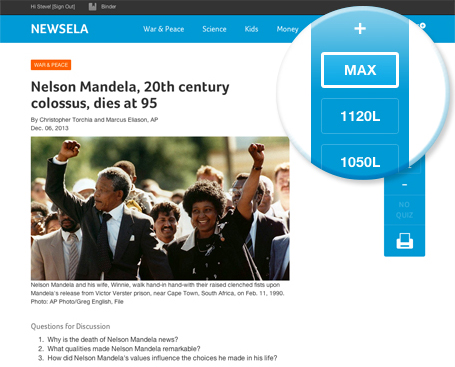 Or, if you really want to help them build background knowledge, vocabulary, and language awareness, have them read the easiest version first. Then a more difficult version. Once they have a basic comprehension from the easier version, they will have a better chance at inferring the meaning of more complex sentences and more sophisticated vocabulary that they encounter. Additionally, the two versions can be used to notice the language used to make sentences more complex, such as dependent clauses, compound predicates, noun phrases, and relative clauses.
I’ve tried this now a couple times with other articles from Newsela and among other things I found the students really appreciated having a sense of control over the topic and a chance to examine the language.
Plus, once you feel confident that all the students understand a topic such as Scalia’s death and the Constitutional implications, the rest of the class discussion tends to flow much better.
Like this:
Like Loading...
 As I continue to work through the “multiple model answer approach” in my experiment with teaching legal writing to LLM students this semester (aka the banana peel/jogger question), I’ve also begun exposing the students to multiple recorded oral model answers for the same question. That is, I’ve recorded a number of native English speaking law students (or law school graduates) answering the the banana peel/jogger question.
 One of the challenges I’ve noticed with my students’ writing is getting them to write in greater volume. I’m not sure if it’s a cultural issue, or simply the way these particular students learned about writing.
 I was having an issue with student lateness early in the semester, despite a lateness policy we discussed as a class the first week. Threats of a lower grade and of required meetings with program directors to discuss recurrent lateness seemed to have little effect. So one day, borrowing a concept I picked up from a parenting book, I presented the question to my students: What would be an appropriate consequence for lateness?
 Using legal humor in class can be an extremely potent tool. It can also be a minefield as humor often does not travel well across cultures. When not well employed in a classroom, it can devolve into a painful over-explanation of a joke to blank and unsympathetic faces. (I speak from experience.)

 I was a bit perplexed this past week when a student submitted an assignment as a Word file, and the name of the file included parentheses in an unexpected way. Like this:
